

If a "Legal Notice of Class Action Settlement" just landed in your inbox or mailbox, you're not in trouble, you're not being sued, and you probably don't need a lawyer. You're most likely a class member: someone a court has decided may be owed money or other relief because of a lawsuit you had nothing to do with filing.
This guide explains what a class action settlement notice is, why it was sent to you specifically, what the deadlines inside it mean, and how to tell a legitimate notice from the scams that imitate them. It's written for the people who receive notices, but if you're on the other side (a claims administrator or counsel deciding how to send one), the last section is for you.
What is a class action settlement notice?
A class action is a lawsuit where one or a few named plaintiffs sue on behalf of a much larger group of people who were affected the same way: customers overcharged the same fee, employees paid under the same policy, consumers whose data was exposed in the same breach.
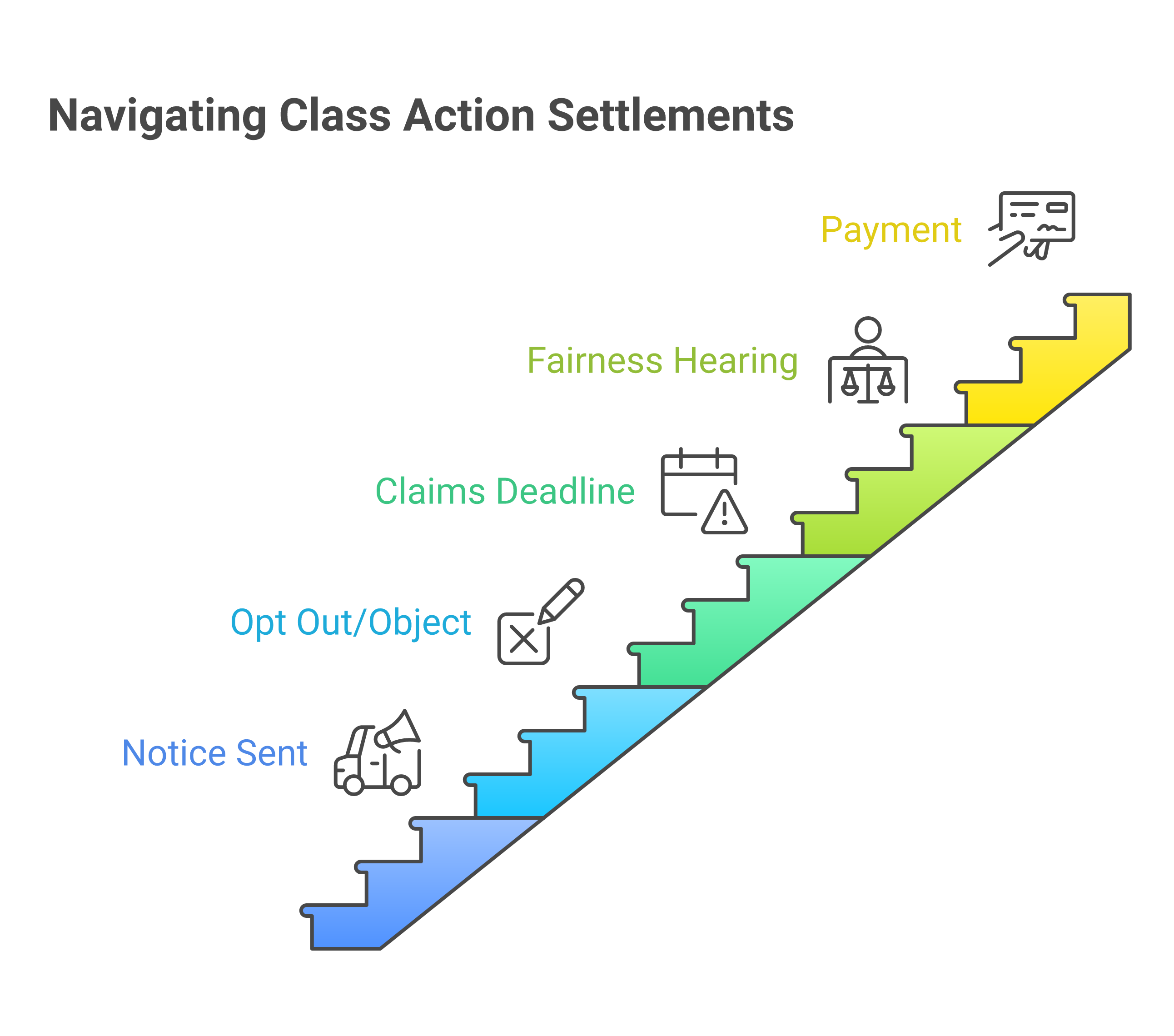
When the two sides agree to settle, the court doesn't just approve the deal in private. Under Federal Rule of Civil Procedure 23(e), the court must direct notice "in a reasonable manner to all class members who would be bound" by the settlement. That notice is the document you received.
Its job is to tell you four things:
- That a lawsuit exists and what it's about.
- That you may be a class member, and how the class is defined.
- What the settlement offers (cash, credits, monitoring, changes to a company's practices) and what you give up by staying in.
- What you can do about it, and by when.
The notice is often labeled "court-ordered" or "court-authorized" because a judge reviewed and approved its wording and its distribution before it went out. That label is a good sign: it means the notice program itself was scrutinized.
Why did I get one?
You received a notice because the defendant's records, or a third-party data source, place you inside the class definition. Common reasons:
- You were a customer or account holder during the "class period" (the date range the lawsuit covers). Data-breach settlements, subscription and auto-renewal cases, and fee cases almost always pull from the company's own customer list.
- You were an employee of the defendant during the class period. Wage-and-hour settlements use payroll records.
- You bought a product that's the subject of the case. Sometimes retailers' loyalty-program data identifies you; sometimes you'll only be reached through publication notice (ads, websites) and have to self-identify.
- Your email was in the records. For settlements approved since 2018, email is often the primary channel, which is why more of these notices now arrive in your inbox than in your mailbox. (Rule 23(c)(2)(B) was amended in December 2018 to explicitly allow notice "by United States mail, electronic means, or other appropriate means.")
You did not opt into the lawsuit. Class actions are "opt-out" proceedings: you're included by default and must take action if you want to be excluded.
The parts of the notice, in plain language
Notices follow a fairly standard structure because the court requires certain content.
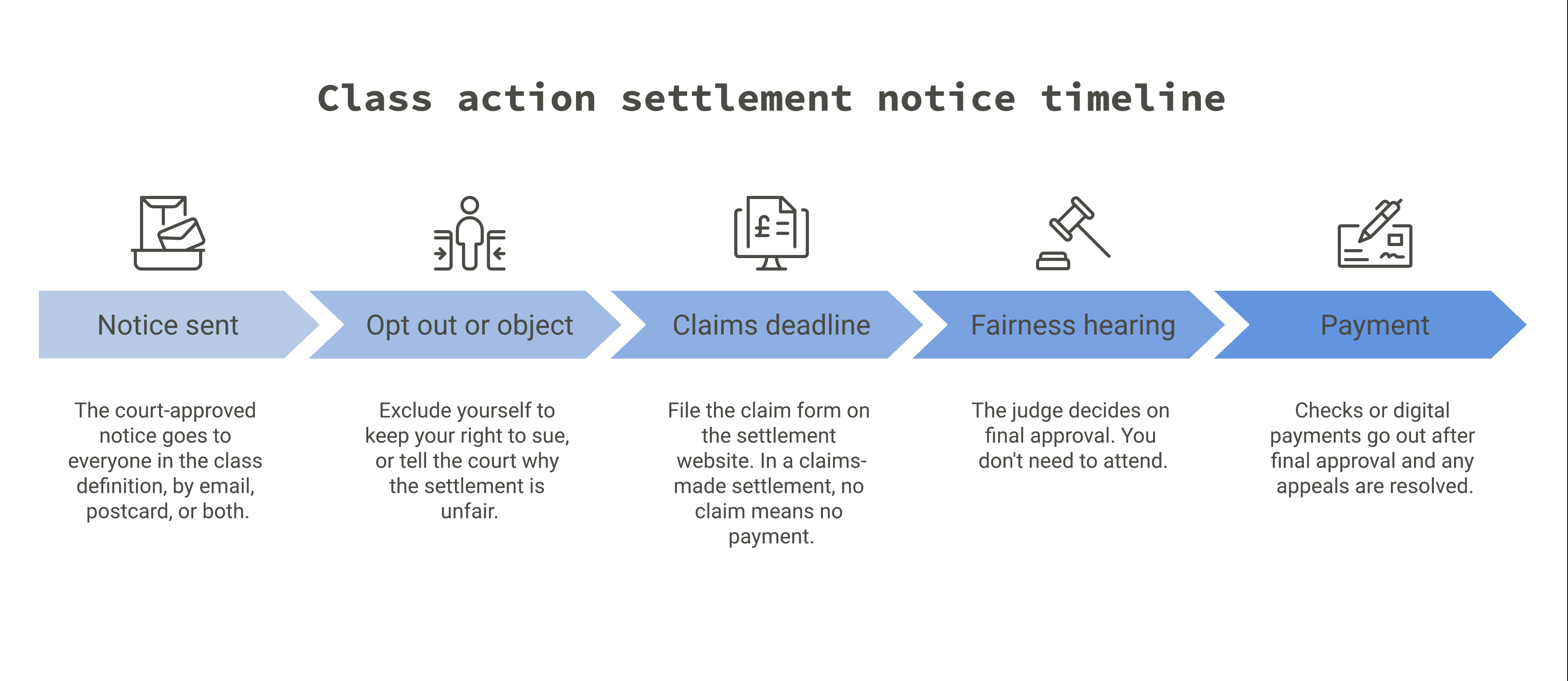
Here's how to read yours.
The case caption
The top of the notice names the case (Plaintiff v. Defendant), the court, and a case number. You can look this up on the court's website or on PACER, and the settlement website will usually link to the key filings. If a notice has no case number or court, treat it with suspicion (see the scam section below).
The class definition
A paragraph that starts something like "All persons in the United States who…" This is the test for whether you're included. Read it carefully: it will name a date range, a product or service, and sometimes a geography.
What the settlement provides
This section describes the settlement fund (say, "$12.5 million") and how it's divided. Pay attention to whether payment is automatic (you'll receive it if you do nothing) or claims-made (you must submit a claim form to get anything). Most consumer settlements are claims-made.
Your options
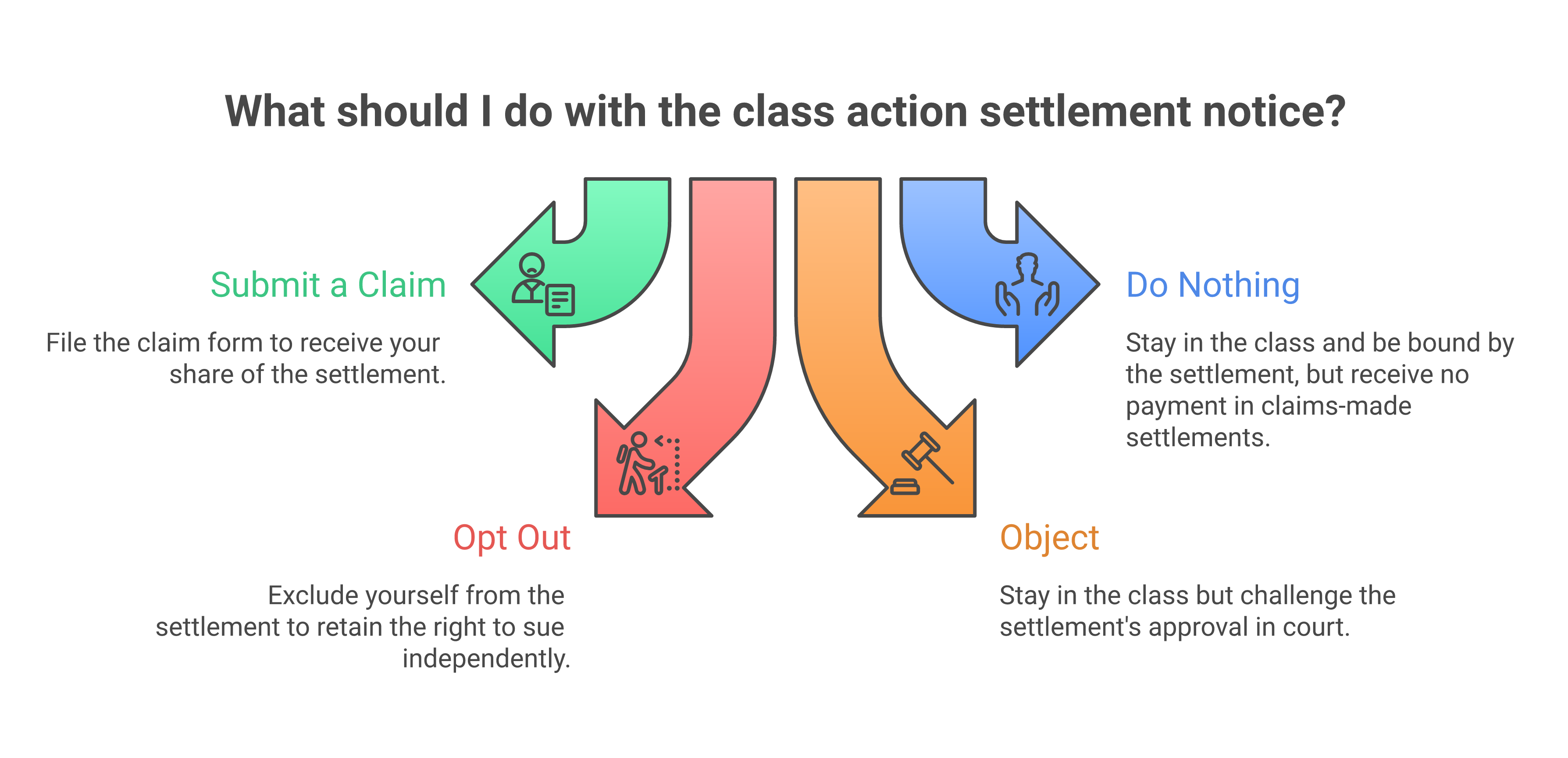
Every notice gives you the same four choices:
| Option | What it means | Typical deadline |
|---|---|---|
| Submit a claim | File the claim form (online or by mail) to receive your share. | Claims deadline, often 60–120 days after notice |
| Do nothing | You stay in the class and are bound by the settlement, but in a claims-made settlement you get no payment. | — |
| Opt out (exclude yourself) | You leave the class, get nothing from this settlement, and keep your right to sue on your own. | Exclusion deadline, usually before the fairness hearing |
| Object | You stay in the class but tell the court why the settlement shouldn't be approved. | Objection deadline, usually the same as the exclusion deadline |
The fairness hearing
A date on which the judge will decide whether to grant "final approval." You don't need to attend. Payments are not sent until after final approval and after any appeals are resolved, which is why settlement checks can arrive many months after the notice.
Attorneys' fees and the named plaintiffs
The notice will disclose how much class counsel is asking for (commonly a percentage of the fund) and any "service award" to the people who brought the case. This is disclosed so you can object to it if you think it's excessive.
What should I actually do?
For most people, the answer is short:
- Confirm you're in the class. Match your dates and account against the class definition.
- Decide whether the claim is worth your time. Some settlements pay a few dollars; data-breach settlements often pay more if you can document losses or time spent.
- File the claim before the deadline, using the settlement website named in the notice, not a link in a forwarded email. Keep the claim ID or confirmation number.
- Watch for follow-ups. Legitimate administrators send reminder notices before the claims deadline and, later, payment notifications. These will come from the same sender and reference the same case.
Opt out only if you intend to pursue your own lawsuit, which for most consumer claims isn't practical. Object only if you have a genuine concern about the terms; objecting doesn't increase your individual payment.
Is this notice legitimate?
This is the question people search for more than any other: "is the [company] settlement email legit," "is [administrator] real." The anxiety is reasonable. Scammers imitate settlement notices because the format asks you to click a link and enter personal information.
A legitimate notice has these properties:
- It never asks for payment. You do not pay a fee to file a claim or to receive a settlement check. Any "processing fee" is a scam.
- It never asks for your full Social Security number or bank login in the initial notice. A claim form may later ask for a last-four SSN or a W-9 for large payments, but that happens on the settlement website, not in the email.
- It names a real court, case number, and administrator. Search the case name on the court's website or on a legal news site. Well-known administrators include Kroll Settlement Administration, Epiq, Angeion Group, JND Legal Administration, Analytics Consulting, and Simpluris. Their names being on a notice doesn't prove it's real, but their absence from the settlement website is a red flag.
- The settlement website is dedicated to the case (for example, [casename]settlement.com) and matches the domain in the email.
- The sending domain matches the administrator or the settlement site, and the email passes authentication. You can't see SPF, DKIM and DMARC results at a glance, but your mail client's "show original" or "view headers" option will show whether they passed. Administrators that take deliverability seriously also use BIMI, which is why some notices show the administrator's logo next to the sender name. (Notices sent through a certified noticing platform such as iPost Assured carry all of these signals by default.)
If you're unsure, don't click anything in the email. Type the settlement website address from the notice into your browser directly, or search the case name and go to the site from the court's or administrator's page. Everything you need, including the claim form, will be there.
What "notice" means to the people who send it
If you're reading this as a claims administrator, settlement counsel, or a company facing its first class action, the notice program is where a settlement succeeds or quietly fails.
Courts evaluate notice against the "best notice that is practicable under the circumstances" standard. Since the 2018 amendments, that increasingly means email first, with postcard mail as a supplement or fallback. Email is faster, cheaper, and measurable, but it carries risks that mail doesn't: a notice that lands in spam is, for the court's purposes, a notice that was never delivered. And a class member who can't tell your notice from a phishing attempt won't file a claim.
The practical consequences:
- Authentication is not optional. SPF, DKIM, DMARC at enforcement, and ideally BIMI, on a dedicated sending domain per matter. Google and Yahoo's bulk-sender requirements apply to notice programs like anyone else; the authentication section of our email marketing best practices guide for 2027 covers the setup, and if you're standing up a new sending domain for a matter, read what IP warm-up is and why it matters before the first send.
- Deliverability is the administrator's responsibility, not the mailbox provider's. A notice that lands in spam is, for the court's purposes, a notice that was never delivered. We've written before about why email deliverability is your fault, and nowhere is that more literally true than in a court-ordered notice program.
- Reminders raise claims rates. A single notice followed by silence leaves money unclaimed; a planned sequence (initial notice, mid-period reminder, deadline reminder) measurably lifts participation. Courts have accepted reminder emails as part of a reasonable notice plan.
- Bounce and engagement data are evidence. Delivery reports, open-rate data read correctly, click data, and bounce reconciliation against the mail file are what you'll cite in the declaration supporting final approval.
- Suppression and consent rules still apply. Legal notice email is transactional in nature, but list hygiene, unsubscribe handling for reminder sequences, and honoring prior opt-outs keep the program off blocklists. The approval workflows, audit trails and suppression controls that make this defensible are the difference between a general ESP and email compliance software built for regulated industries.
This is the work iPost has done for more than twenty years: email delivery for class action settlement organizations, with case and claim codes merged at send time, custom reporting for the courts and case teams, and iPost Assured, our verified and certified class action noticing platform that produces the proof of delivery attempts and outcomes a fairness hearing asks for. For a broader look at what separates a general ESP from a platform built for this kind of sending, see which enterprise email platforms are built for highly regulated industries, or browse our case studies. If you're planning a notice program, contact us about what a compliant email notice plan looks like for your matter.
Frequently asked questions
Why did I get a notice of class action settlement? Because the defendant's records (customer, employee, or purchase data) place you inside the class definition for the lawsuit. You were not required to do anything to be included.
What is a class action settlement notice? A court-approved document informing potential class members that a lawsuit has been settled, what the settlement provides, and what their options and deadlines are. It's required by Rule 23(e) of the Federal Rules of Civil Procedure (and equivalent state rules).
Is a "court-ordered notice of class action settlement" different from a regular notice? No. "Court-ordered" or "court-authorized" simply signals that the judge approved the notice's content and distribution. Most settlement notices are court-ordered.
Do I have to respond? No. If you do nothing, you remain in the class. In a claims-made settlement, though, doing nothing means you won't receive a payment.
How long until I get paid? Typically several months after the fairness hearing, and longer if there's an appeal. Check the settlement website for status updates.
What is a Class Action Fairness Act (CAFA) notice? Something different. Under 28 U.S.C. § 1715, defendants must notify federal and state officials of a proposed settlement. That notice goes to attorneys general, not to class members.
Can a legal notice be sent by email? For class action settlement notice, yes. Since December 2018, Rule 23(c)(2)(B) expressly allows notice by "electronic means." Many state courts follow the same approach. Whether email satisfies notice requirements in other legal contexts (contracts, evictions, service of process) depends on the statute or agreement involved.
This article explains class action notices in general terms and is not legal advice. If you have questions about a specific settlement, contact the claims administrator listed on your notice or consult an attorney. Settlement administrators and counsel: learn how iPost handles court-ordered settlement email.