
Integration, identity, and governance are less glamorous than AI, and far more decisive
Rich in data, poor in insight
Scholarly publishers and societies are, by almost any measure, data-rich organizations. Over the course of a single year, the same researcher might submit a manuscript, review two others, renew a society membership, register for an annual meeting, subscribe to several table-of-contents alerts, and read dozens of articles on the publisher's platform. Each of those interactions is recorded somewhere, yet in most organizations they are recorded in different places: a submission and peer review system, a membership or association management database, an email platform, a web analytics tool, an events registration system, and often a CRM that only partly overlaps with all of them.
The consequence is a peculiar paradox in which an organization knows a great deal about its community in aggregate but very little about any individual within it. A 2023 essay in The Scholarly Kitchen captured the problem well, observing that the same person may simultaneously be a member, an author, an attendee, a reviewer, and a reader, and that seeing them one silo at a time makes it nearly impossible to understand the relationship as a whole. Consider a cardiologist who has published in a society's flagship journal, reviews for it regularly, and has attended the annual meeting for a decade. If that person receives the same generic newsletter as a first-year graduate student, along with a membership solicitation even though they are already a member, the problem is not a lack of data. The problem is that the data has never been introduced to itself. In our previous post we described what meaningful personalization actually looks like; this one is about the customer data integration work that has to happen first.
Why AI cannot compensate for disconnected data
It is tempting to believe that artificial intelligence will resolve this fragmentation on its own, and many personalization pitches implicitly promise exactly that. The evidence points firmly in the other direction. In a survey of data management leaders conducted in 2024, Gartner found that 63% of organizations either lack or are unsure whether they have the data management practices needed to support AI, and the firm predicts that through 2026, organizations will abandon 60% of AI projects that are not supported by AI-ready data.
The reason is straightforward once the mechanics are considered. A recommendation model can only reason about the records it is given, so when a single researcher exists as four partial records across four systems, the model sees four thin profiles instead of one rich one. It cannot recognize that the author, the reviewer, and the alert subscriber are the same person, and it will make inferences accordingly. Data quality compounds the problem. In a widely cited study published in Harvard Business Review, Tadhg Nagle, Thomas Redman, and David Sammon asked managers at 75 organizations to audit their most recent data records and found that only 3% of the resulting scores met even a basic standard of acceptability. An algorithm applied to data of that quality does not correct the errors; it scales them.
The identity problem unique to scholarly publishing: why ORCID matters
Publishers face an additional challenge that most consumer brands do not, which is that researcher identity is unusually difficult to resolve. Academics change institutions and therefore institutional email addresses, often several times across a career. They may submit a manuscript using a university address, register for a conference with a personal one, and subscribe to alerts with a third. Names appear with and without middle initials, in different transliterations, and in different orders depending on cultural conventions and the system collecting them.
This is precisely why persistent identifiers deserve a central place in any integration effort. An ORCID iD, which many researchers already attach to their submissions, offers a stable key that survives changes in employer and email address and can anchor records that would otherwise never be matched. Publishers that capture ORCID iDs consistently at registration, submission, and membership renewal give themselves a far more reliable foundation for unifying reader data than any amount of fuzzy name matching could provide.
Governance is not a footnote
Connecting systems is a technical exercise, but deciding what may be done with the connected data is a governance question, and in scholarly publishing it carries particular weight. Three questions deserve explicit, documented answers before any integration project begins.
The first is who owns the reader relationship. In society publishing, a journal is frequently published in partnership with a commercial publisher, and the contract between them determines which party controls subscriber, author, and usage data and on what terms it may be shared. Many organizations discover that the answer is ambiguous only when they try to act on it.
The second is what each piece of data may legitimately be used for. Information collected for one purpose cannot automatically be repurposed for another, a principle formalized in data protection frameworks such as the GDPR and reinforced by the ethical norms of scholarly communication. Peer review data is the clearest example. The fact that a researcher reviewed a particular manuscript is confidential, and using it to inform marketing would breach both the trust of the reviewer and the integrity of the review process. A responsible integration therefore defines not only which systems connect, but which fields are allowed to cross between them. (This is the same discipline that separates email compliance software built for regulated industries from a general-purpose sending tool.)
The third is whether any of this is written down or merely understood by a few long-serving staff members. Institutional knowledge that lives only in people's heads tends to leave with them, and it cannot be audited, explained to partners, or applied consistently by new tools. Gartner predicts that by 2027, 80% of data and analytics governance initiatives will fail, largely because they are not tied to a pressing business need. That finding suggests a practical opportunity, since a concrete goal such as delivering relevant content to members gives governance the clear purpose it otherwise lacks.
Choosing the first two systems to connect
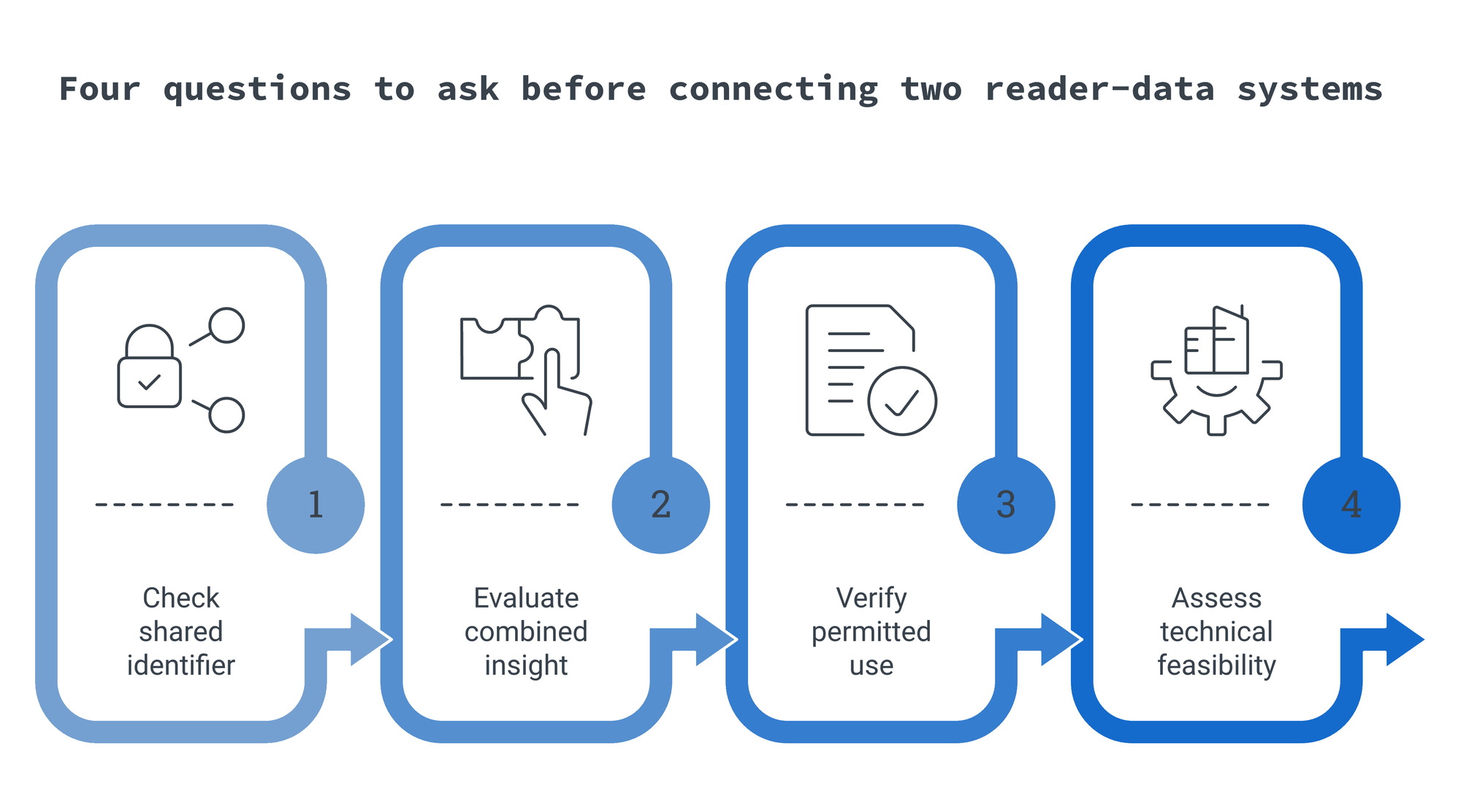
Most organizations cannot unify everything at once, nor should they try. A more productive question is which two systems, if connected, would unlock the most value with the least risk, and the answer depends on four criteria: whether the systems share a reliable identifier, how valuable the combined insight would be, how clearly the use is permitted under existing consent and contracts, and how feasible the technical connection is.
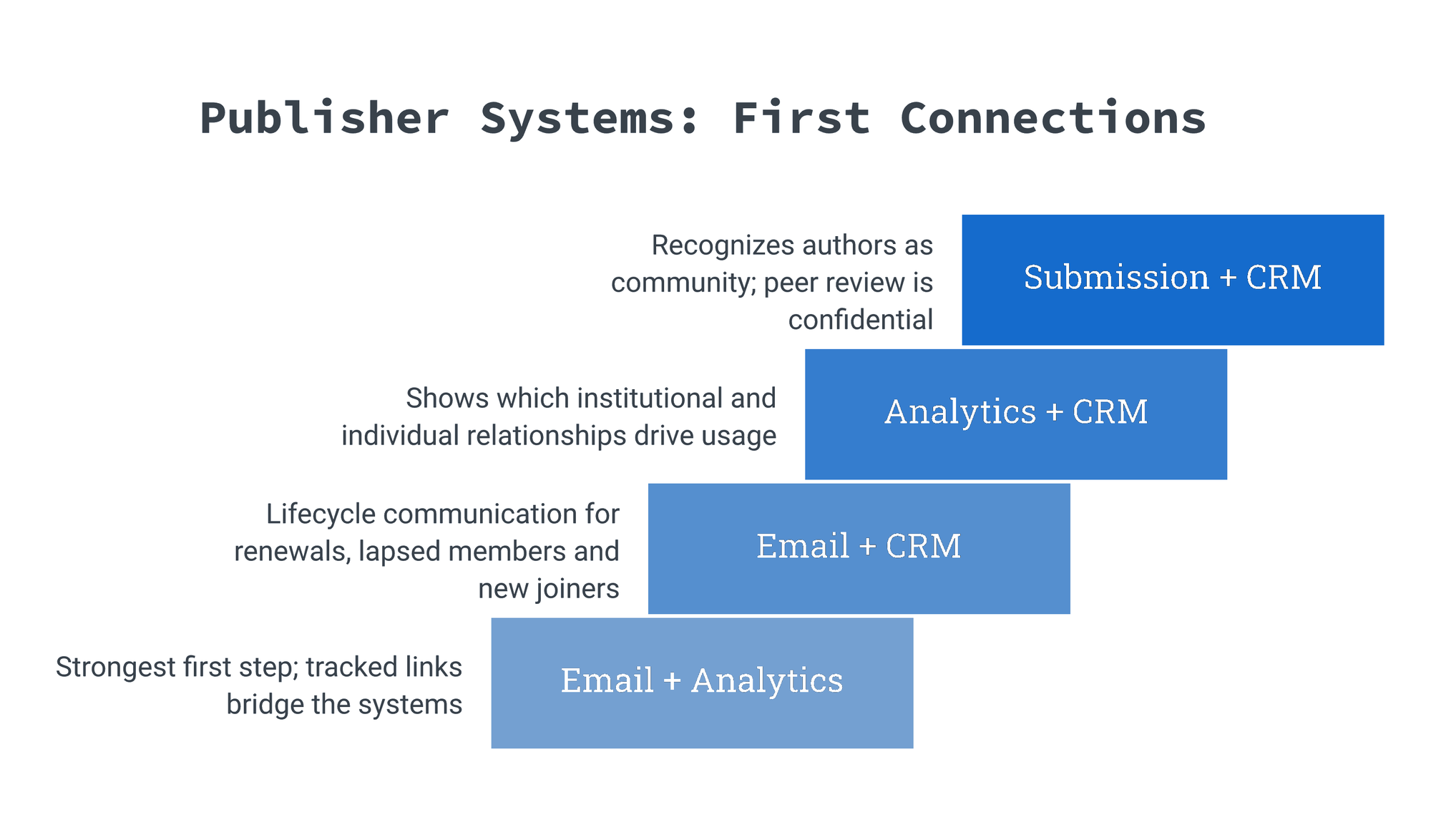
Applied to common scholarly publishing pairings, these criteria produce different conclusions. Connecting email with web analytics is often the strongest first step, because tracked email links create a natural bridge between the two systems, the consent context is already aligned, and the result immediately distinguishes a reader who clicked from one who actually read the article (a distinction that matters more every year as open rates become less reliable). Connecting email with the membership database or CRM supports lifecycle communication, so that renewals, lapsed members, and new joiners each receive appropriate messages instead of the same one. Connecting the submission system with the CRM can be enormously valuable for recognizing authors as part of the community, but it requires the most careful governance, given the confidentiality obligations surrounding peer review. Connecting web analytics with the CRM, meanwhile, helps reveal which institutional and individual relationships are actually driving usage.
A measured path forward
The organizations that succeed with personalization tend to begin with an inventory rather than a model. That means mapping every system that holds reader data, along with its owner, the identifier it uses, the consent basis under which its data was collected, and how often it is refreshed. From there, they define how records should be matched, ideally anchored by ORCID iDs and verified email addresses, select a single pilot use case, and measure whether connected data produces measurably better engagement than the fragmented approach it replaces.
None of this work is likely to feature in a conference keynote, and it rarely generates the excitement that accompanies a new AI capability. It is, however, the work that determines whether those capabilities deliver anything of value. Publishers that invest first in connected, well-governed reader data will find that personalization becomes far easier, far more accurate, and far more trustworthy, while those that skip the foundation will continue to discover that even the smartest algorithm cannot make sense of a community it has only ever seen in pieces. If the email-plus-analytics connection is your first step, iPost's integrations and publishing platform solutions are built for exactly that pairing — talk to us about a pilot.
Continue the conversation
This article builds on a conversation from our short video series with Samast AI, From Content to Community, in which experts in scholarly publishing, data, and responsible AI explore how publishers and societies can use audience insights, personalization, and emerging technology to build stronger relationships with their readers. Each episode runs about two minutes and takes on a single question, from which reader signals matter most to why connected, well-governed data matters more than any algorithm.
Watch the full series on YouTube: From Content to Community — STM Publishing playlist.
FAQ: Connected Reader Data
What is customer data integration for a publisher?
Connecting the systems that each hold part of a reader's record — submissions, peer review, membership or CRM, email, web analytics, events — so that one researcher is recognized as one person, under rules that say which fields may be shared.
Why can't AI fix fragmented reader data?
A model only reasons over the records it is given. Four partial profiles produce four thin inferences, and poor-quality data is scaled rather than corrected.
What is ORCID and why does it matter here?
ORCID is a persistent identifier for researchers that survives changes of institution and email address, which makes it the most reliable key for matching records across systems.
Which two systems should be connected first?
Email and web analytics, in most cases: they share tracked links as an identifier, the consent context is aligned, and the result separates readers who clicked from readers who read.
Sources
- Gartner (2025). Lack of AI-Ready Data Puts AI Projects at Risk.
- Gartner (2024). Gartner Predicts 80% of D&A Governance Initiatives Will Fail by 2027.
- Nagle, T., Redman, T.C., and Sammon, D. (2017). Only 3% of Companies' Data Meets Basic Quality Standards. Harvard Business Review.
- The Scholarly Kitchen (2023). Can You Really Know Your Customer If You Only See Them One Silo at a Time?