
Email marketing is easy to start.
Doing it well is much harder.
The best email marketing practices are not about finding one perfect subject line, send time, or template. Strong email programs combine permission, segmentation, useful content, smart cadence, good design, clean data, solid technical infrastructure, and continuous email campaign optimization.
That matters more than ever because inbox providers are raising the bar. Gmail requires bulk senders to meet authentication, spam-rate, and one-click unsubscribe requirements, while subscribers have more control over which senders stay in their inbox.
TL;DR: Email Marketing Best Practices
The most important email campaign best practices are simple: build permission-based lists, confirm subscribers, segment instead of blasting everyone, write clear subject lines, design for mobile devices, use one obvious call to action, authenticate with SPF, DKIM, and DMARC, make unsubscribing easy, maintain a predictable cadence, re-engage inactive subscribers, and measure clicks, conversions, and revenue instead of relying only on opens.
Everything else is optimization.
What Are Email Marketing Best Practices?
Email marketing best practices are the strategic, creative, technical, and operational standards that help marketers send more relevant email while protecting deliverability and producing measurable business results.
Good email marketing guidelines should help you answer four questions:
Are we sending to people who actually want this?
Are we sending something relevant?
Can the message reliably reach the inbox and work correctly?
Did the campaign produce the action we wanted?
If the answer to one of those questions is no, better copy alone probably will not fix the campaign.
1. Build Your Email List Around Permission
The foundation of every good email program is permission.
Do not buy email lists. Do not scrape addresses. Do not quietly add people to marketing programs because they filled out an unrelated form.
Instead, create a clear signup experience that tells subscribers what they will receive.
Google's current guidance recommends confirming email addresses after signup before sending subscription messages—sometimes called double consent or double opt-in.
Double opt-in can create a little more friction, but it also gives you a cleaner signal that the subscriber genuinely wants your messages.
The golden rule of email marketing is still remarkably simple:
Send email people actually asked to receive.
2. Never Treat List Size as the Goal
A database with 2 million addresses is not automatically more valuable than a database with 500,000 engaged subscribers.
List health matters more than vanity size.
That means watching:
- invalid addresses
- hard bounces
- long-term inactivity
- spam complaints
- unsubscribes
- engagement by segment
iPost has talked about the importance of periodically cleaning your email lists because continuing to send to people who consistently show no interest does not make your program stronger.
It usually does the opposite.
3. Segment Before You Send
One of the most reliable best practices for email marketing is also one of the most ignored:
Stop sending everything to everyone.
Segmentation can be based on:
- lifecycle stage
- customer status
- purchase history
- engagement
- geography
- interests
- content preferences
- loyalty level
- behavioral data
For a casino, that might mean player value, property, game preference, or visit frequency.
For a publisher, it could mean journal interests, subscriber status, or content consumed.
For a franchise organization, it may mean market, franchisee status, lead stage, or local location.
Strong segmentation makes personalization easier because you are starting with a relevant audience instead of trying to personalize a bad send after the fact.
4. Personalize Around Behavior, Not Just First Name
“Hi, Shaun” is not a personalization strategy.
Useful personalization answers:
Why should this person receive this message right now?
Good personalization might change:
- content
- offer
- recommended product
- event
- location
- timing
- CTA
- send frequency
The best email marketing strategies use customer data to make the message more useful, not simply more personal-looking.
This is also one reason sophisticated email programs need an ESP capable of working with complex customer data rather than forcing every campaign into the same batch-and-blast workflow.
5. Write Subject Lines for Clarity First
Your subject line has one job:
Earn enough interest for the subscriber to open.
Do not bury the point.
Strong subject lines are usually:
- specific
- easy to understand
- aligned with the content
- short enough to scan on mobile
- interesting without being misleading
And always pair the subject line with useful preview text.
If you are trying to improve this part of your program, start by understanding how subject performance influences email open rates.
Just remember that opens should not be your only performance metric because privacy changes have made them noisier.
6. Use a Recognizable From Name
People decide whether to trust an email before reading the body.
Your From name is part of that decision.
Use a recognizable brand or person associated with the brand. Avoid unnecessarily obscure sender names and think carefully before relying on “no-reply” addresses for marketing communications.
Email works because it feels more direct than many advertising channels.
Do not intentionally make it feel less human.
7. Design Mobile First
A good email should not merely “work” on mobile.
It should be designed with mobile use in mind from the beginning.
That means readable text, enough white space, buttons that are easy to tap, layouts that stack properly, and important information that is easy to find without excessive scrolling.
This is where email content best practices and technical development meet. The creative can be excellent and still fail if it renders poorly in real inboxes. iPost's discussion of Email Development 101 goes deeper into rendering, development, dark mode, and cross-client compatibility.
Use high-quality, properly licensed images where visuals genuinely improve the message, but do not build an email that depends entirely on images to communicate its point.
8. Give Every Email a Clear CTA
One of the easiest email campaign tips to implement is also one of the most valuable:
Make the next action obvious.
A promotional campaign might ask the subscriber to:
- shop now
- reserve a seat
- claim an offer
- read an article
- book a consultation
- renew a subscription
Your CTA should not make the recipient guess.
That does not mean every email needs only one link. Newsletters and content digests naturally contain multiple destinations. But every campaign should still have a clear hierarchy.
If the goal is an event registration, for example, your CTA should behave differently from a multi-topic newsletter. iPost's guide to writing an event invitation email shows how that distinction changes both design and copy.
9. Maintain a Predictable Sending Cadence
More email does not automatically create more revenue.
Sometimes it creates fatigue.
Subscribers learn what to expect from brands. A company that sends twice a month and suddenly sends twice a day changes the relationship.
Monitor unsubscribe and complaint behavior whenever cadence increases.
This is particularly important because the inbox makes leaving easier than it once was. iPost's analysis of why email unsubscribe rates are rising shows why cadence control, segmentation, and re-engagement are increasingly connected.
The better question is not:
How often can we send?
It is:
How often can we send something this audience actually values?
10. Make Unsubscribing Easy
Trying to hide the unsubscribe link is not a retention strategy.
It is a spam complaint strategy.
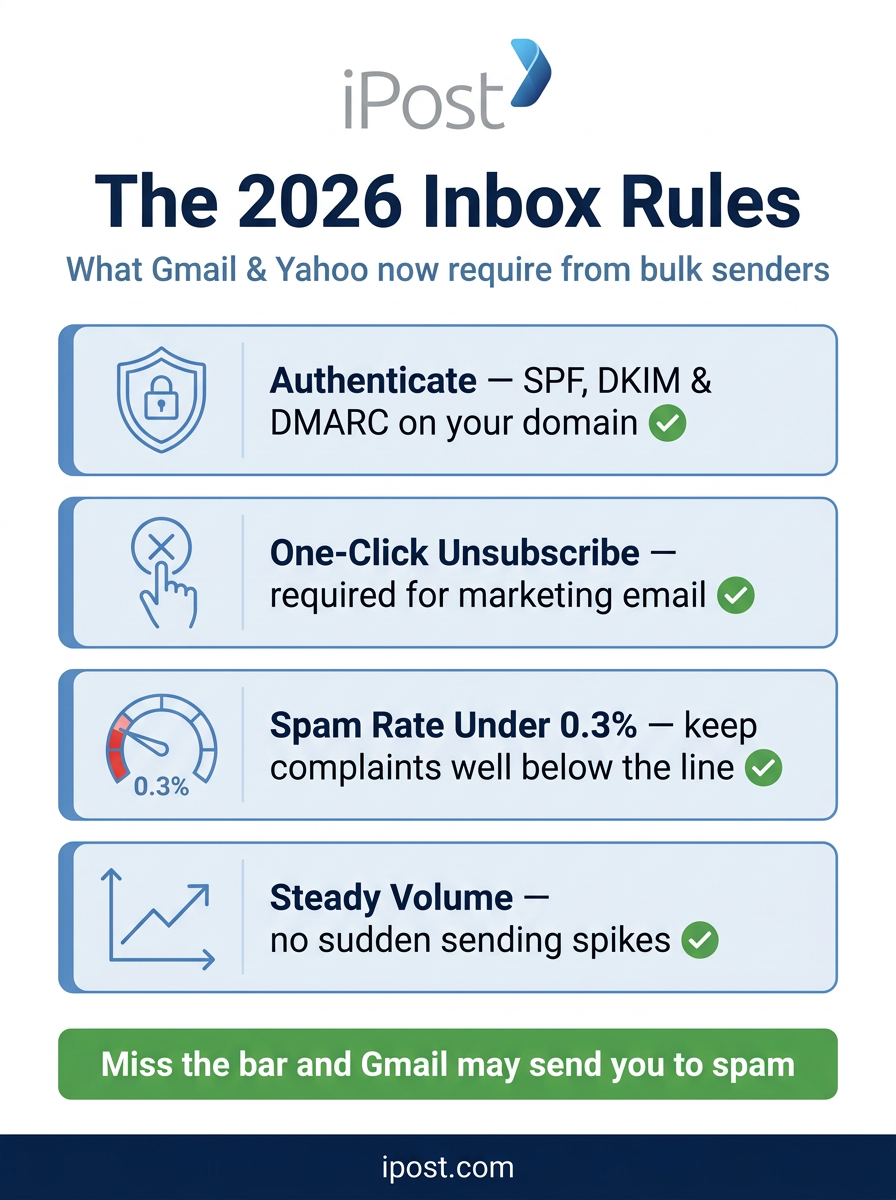
Google requires marketing messages from bulk senders to support one-click unsubscribe in addition to having a clearly visible unsubscribe option in the email. Gmail also states that bulk senders who do not meet sender requirements may experience spam placement or delivery disruption.
Yahoo has similarly pushed senders toward one-click unsubscribe, describing easy opt-outs as helpful for engagement and sender reputation.
If somebody does not want your email anymore, let them leave.
Protect the relationship with the people who remain.
11. Re-Engage Before Subscribers Disappear
Do not wait until an inactive subscriber clicks unsubscribe.
Use declining engagement as a trigger.
A re-engagement campaign can:
- remind subscribers why they joined
- let them change preferences
- reduce their frequency
- show them different content
- ask whether they still want to hear from you
If they still do not engage, consider suppressing them.
This is good list management and good sender hygiene.
12. Authenticate Your Sending Domain
Modern email campaign best practices are not just creative.
Technical infrastructure matters.
Google requires bulk senders to Gmail to use SPF, DKIM, and DMARC, along with aligned authentication and additional sender requirements.
If those acronyms are unfamiliar, iPost's guide to authenticating email with SPF, DKIM, and DMARC walks through exactly what each protocol does.
Authentication does not guarantee inbox placement.
But poor authentication can absolutely make inbox placement harder.
13. Protect Sender Reputation
Sender reputation is built over time.
Mailbox providers look at signals like:
- authentication
- complaints
- engagement
- bounce behavior
- sending patterns
- volume changes
Google currently tells senders to keep reported spam rates below 0.3%, and recommends keeping them considerably lower when possible.
Avoid dramatic sending-volume spikes, especially from new infrastructure.
Infrastructure decisions matter too. The discussion around dedicated IPs, sender reputation, and changing email metrics is worth understanding before assuming that simply moving to a dedicated IP will solve a deliverability problem.
14. Build Governance Into Your Email Process
This is one area many generic email best practices guides barely address.
As email programs grow, process becomes part of performance.
Strong email governance best practices should define:
- who can build campaigns
- who can access data
- who approves content
- who has send permissions
- how templates are controlled
- how suppression rules are enforced
This becomes particularly important for regulated industries, casinos, publishers, franchises, and multi-brand organizations.
If approvals, audit trails, and permissions are becoming operational pain points, iPost's guide to email compliance software for regulated industries covers what enterprise teams should look for.
15. A/B Test One Meaningful Variable at a Time
Testing is how email campaign optimization becomes a process rather than a guess.
You can test:
- subject lines
- preview text
- CTA language
- creative
- offer structure
- send time
- personalization
- landing pages
But avoid testing five major variables simultaneously and then pretending you know why performance changed.
Form a hypothesis.
Change something meaningful.
Measure the result.
Apply the learning.
That is a much better email campaign strategy than chasing universal “best send time” rules.
16. Match the Email Type to the Objective
Different campaigns need different rules.
A welcome email should not be evaluated exactly like a promotional blast.
A transactional email should not be written like a newsletter.
A webinar invitation should not look like a product digest.
If your team is still unclear about the role of newsletters, start with iPost's guide to what a newsletter is and how to measure one.
This matters because email promotion best practices are often different from educational or relationship-building sends. The objective determines the copy, CTA, cadence, and success metric.
17. Measure More Than Open Rate
Open rate still tells you something.
It just cannot tell you everything.
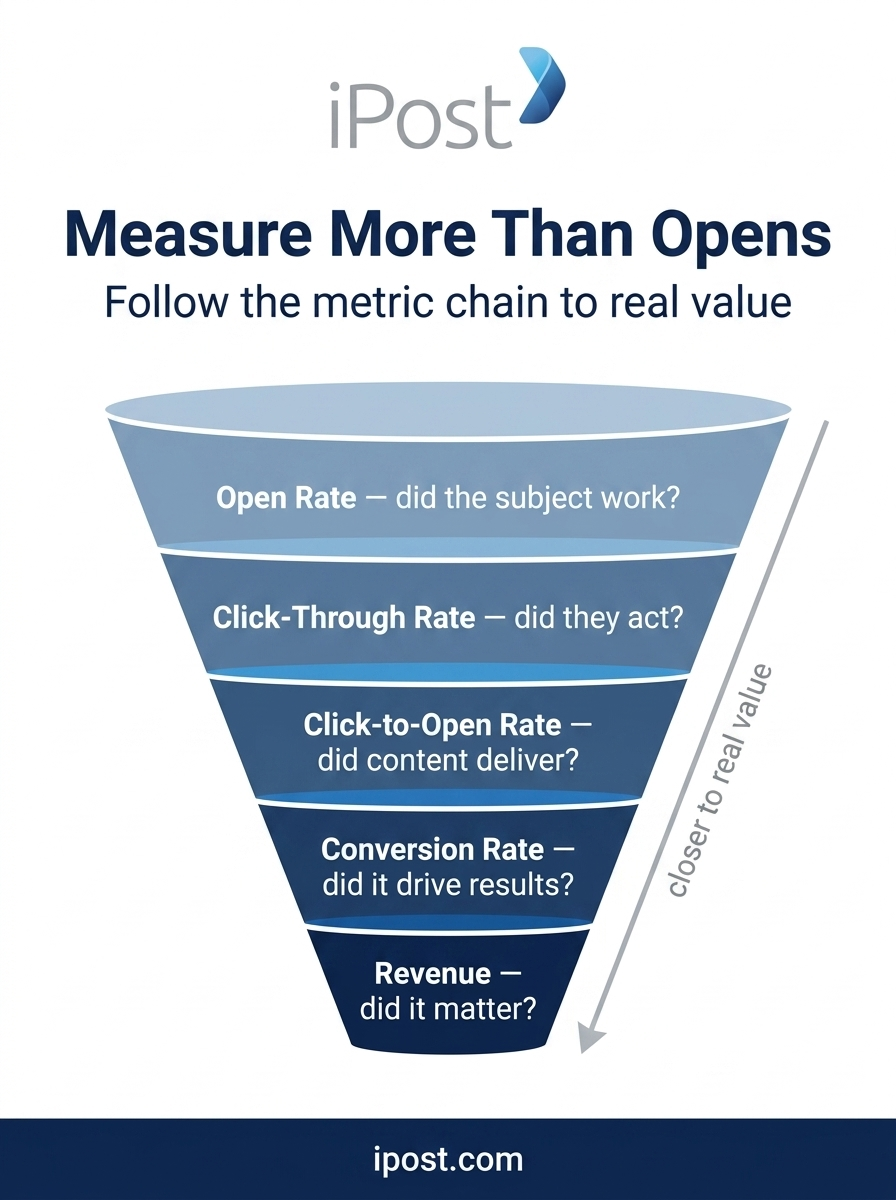
A more useful measurement stack includes open rate, click-through rate, click-to-open rate, conversion rate, unsubscribe rate, complaint rate, bounce rate, and ultimately business outcomes.
iPost's email metrics cluster goes deeper into:
Understanding Email Open Rates, Click-Through Rate in Email Marketing, and Click-to-Open Rate (CTOR).
Think of them this way:
Open rate helps diagnose inbox and subject-line performance.
CTR shows how many delivered emails generated an intentional click.
CTOR helps evaluate what happened after someone opened.
Conversion rate shows whether the traffic created the business result you wanted.
The further down that chain you measure, the closer you get to real value.
18. Optimize the Landing Experience Too
Your email cannot carry the entire conversion.
If a great campaign sends subscribers to a confusing, slow, or irrelevant landing page, the email may show a strong CTR while revenue remains weak.
That is why email marketing campaign best practices should include post-click optimization.
Message, offer, imagery, and expectations should continue from email to landing page.
Do not treat the click as the finish line.
19. Maintain Brand Consistency Without Making Every Email Identical
People should recognize your emails.
That means maintaining consistency around:
- voice
- visual identity
- sender
- layout patterns
- button treatment
- value proposition
But consistency does not mean creative stagnation.
Your transactional email, promotional email, event invite, and newsletter can have distinct designs while still clearly coming from the same organization.
That balance is part of good marketing email best practices: familiar enough to build trust, flexible enough to fit the message.
20. Review Your ESP as Your Program Gets More Complex
Sometimes the problem is not your strategy.
It is the infrastructure underneath it.
As organizations grow, they may need more sophisticated:
- segmentation
- data integration
- governance
- permissions
- approval workflows
- deliverability support
- automation
- reporting
Moving platforms is not something to do casually, but staying on an ESP that no longer fits the business can create its own problems. iPost's lessons from ESP migrations cover why preparation, data understanding, and cross-functional alignment matter when making that transition.
Email Campaign Optimization: What to Check Before Every Send
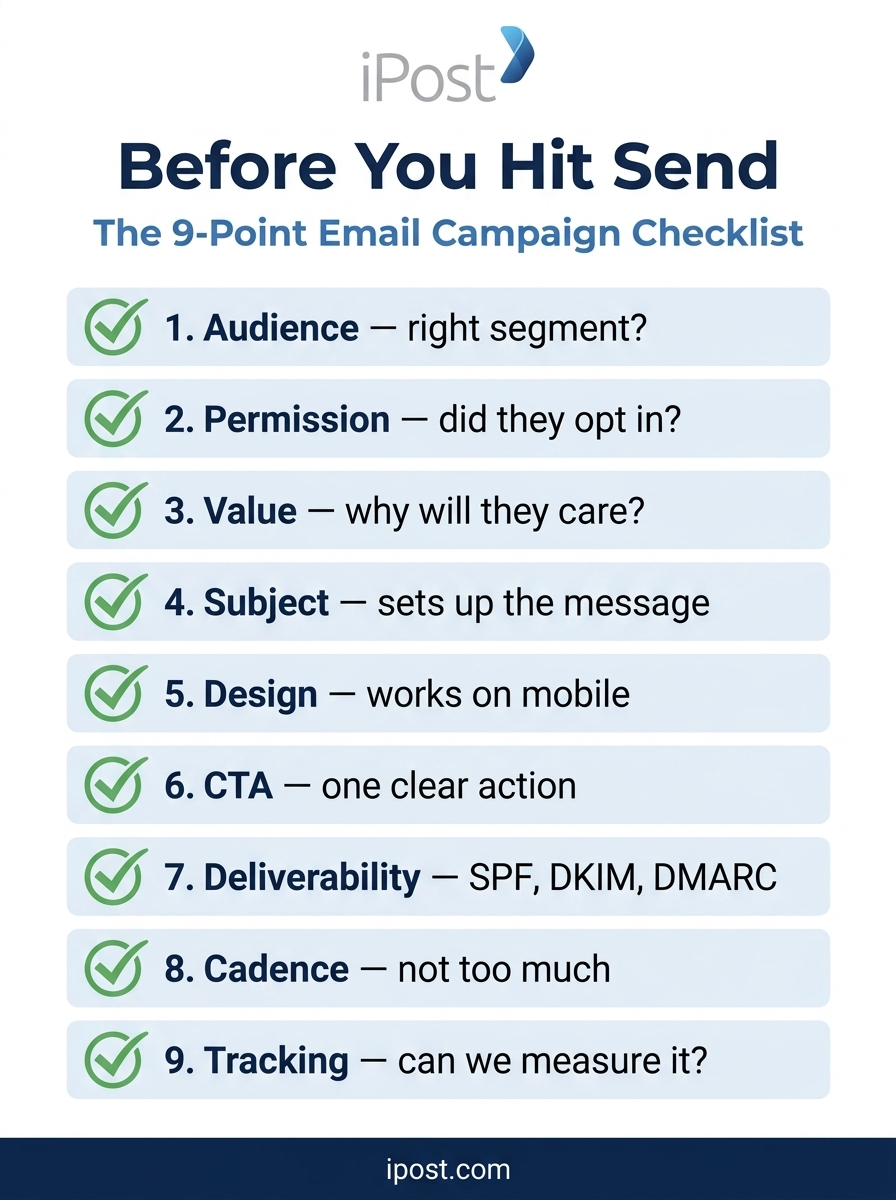
Before a campaign goes live, ask yourself:
Audience: Is this the right segment?
Permission: Did these people actually opt in?
Value: Why should the recipient care?
Subject: Does it accurately set up the message?
Design: Does it work on mobile?
CTA: Is the primary action clear?
Deliverability: Are authentication and list health in good shape?
Cadence: Have we already emailed this audience too much?
Tracking: Will we be able to measure what happened afterward?
If you can answer those questions confidently, you are already ahead of a lot of email programs.
The Best Email Marketing Strategy Is Relevance at Scale
The phrase email marketing best practices can make email sound like a checklist.
It is not.
The best email marketers understand that the rules exist to support one larger objective:
Send the most relevant message you can, to the right audience, at the right moment, without abusing the privilege of having access to their inbox.
Permission protects your list.
Segmentation improves relevance.
Design improves usability.
Authentication protects deliverability.
Cadence protects attention.
Testing improves performance.
Measurement tells you whether any of it actually worked.
That is what best practice email marketing looks like in 2026.
Email Marketing FAQs
What are the most important email marketing best practices?
The most important practices are permission-based list building, segmentation, relevant content, mobile-first design, clear CTAs, consistent cadence, easy unsubscribe options, good list hygiene, SPF/DKIM/DMARC authentication, and ongoing performance measurement.
What is the golden rule of email marketing?
The golden rule is to send useful email to people who actually asked to receive it. Every other best practice—segmentation, personalization, cadence, and deliverability—supports that principle.
What is the 80/20 rule in email marketing?
The 80/20 rule is commonly used as a content guideline suggesting that most communication should provide value while a smaller portion focuses directly on promotion. It is not a technical rule, and the right mix depends on your audience and business model.
How often should marketing emails be sent?
There is no universal ideal frequency. The right cadence depends on audience expectations, campaign type, engagement, and value. Monitor unsubscribe rates, complaints, clicks, and conversions as frequency changes rather than relying on a fixed industry rule.
What makes an email marketing campaign successful?
A successful campaign reaches the right audience, earns attention, delivers relevant content, drives the intended action, and produces measurable business value without damaging list health or sender reputation.
What metrics should email marketers track?
At minimum, marketers should monitor delivery and bounce rates, open rate, CTR, CTOR, conversions, unsubscribe rate, spam complaints, and revenue or business outcomes attributable to the campaign.
Do bulk email senders need SPF, DKIM, and DMARC?
For Gmail, senders classified as bulk senders must authenticate with SPF and DKIM and publish a DMARC record. Google also requires one-click unsubscribe for marketing and promotional traffic and expects senders to maintain low spam complaint rates.