
1-Minute Recap
If you’re just here for the quick answer to “what is a newsletter?”:
- A newsletter is a recurring email (or series of emails) that shares updates, insights, and curated content with a defined audience that asked to hear from you.
- Unlike one-off promotions, good newsletters are built to deliver value first—then earn trust, traffic, and revenue over time.
The most effective newsletters are:
- Segmented (not one-size-fits-all blasts)
- Tied to a clear purpose (educate, nurture, retain, or sell)
- Measured with real metrics like open rate, click-through rate (CTR), and click-to-open rate (CTOR), not just “we sent it.”
We’ll break down what a newsletter is, why it still matters (even in an AI + social-first world), and how to build one your subscribers actually want to read.
What Is a Newsletter?
A newsletter is a recurring email sent to people who opted in, designed to keep them informed, engaged, and connected to your brand, product, or content.
In practice, a newsletter:
- Goes to a subscriber list (not a purchased list)
- Arrives on a predictable schedule (weekly, monthly, etc.)
- Delivers useful content—news, tips, stories, or curated links
- Often includes light promotion, but isn’t 100% sales copy
Think of it as your owned media channel in the inbox. Social feeds can throttle reach. Algorithms change. But when someone joins your newsletter, they’re saying:
“I want to hear from you directly. Don’t make me regret that.”
How Is a Newsletter Different from Other Email Types?
A lot of teams use “newsletter” to describe any email with more than one link. That’s not wrong, but it’s not very helpful.

Here’s how newsletters differ from other common email types:
Promotional campaigns
- Goal: immediate action (buy now, book now, register)
- Often tied to a specific offer, sale, or event
Transactional messages
- Goal: confirm or inform (receipt, booking confirmation, password reset)
- Triggered by a user action
Automated journeys
- Goal: nurture or guide (welcome series, post-purchase, reactivation)
- Behavior-based, usually 1:1
A newsletter usually sits in between:
- Less urgent than a flash sale
- More editorial than a receipt
- More “magazine” than “automation rule”
The best programs use all of these together. Your newsletter keeps people engaged; your triggered emails move them through a journey; your campaigns and offers capture demand when it’s there.
If you want a refresher on how we measure the performance of those other email types, see:
- Understanding Email Open Rates
- Click-Through Rate (CTR) in Email Marketing
- Click-to-Open Rate (CTOR) in Email Marketing
What Is the Purpose of a Newsletter?
At a high level, newsletters exist to maintain and deepen relationships with people who already raised their hand.
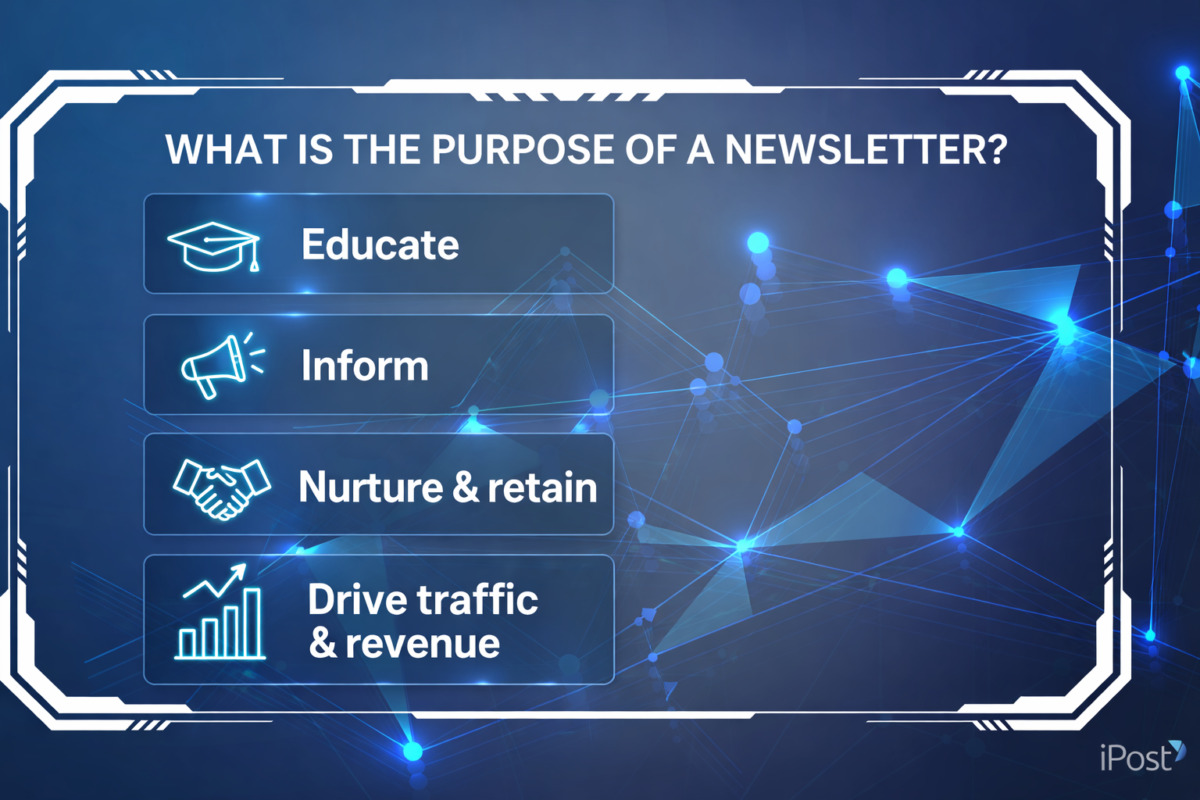
More specifically, strong newsletters usually do at least one of these:
Educate
- Share how-to content, insights, or analysis
- Help readers do their job better or make better decisions
Inform
- Announce product updates, roadmap news, and company milestones
- Curate industry news so subscribers don’t have to hunt for it
Nurture & retain
- Stay top-of-mind between purchases or visits
- Turn one-time buyers into loyal customers
Drive traffic & revenue
- Send subscribers to your website, app, or landing pages
- Promote webinars, events, offers, or loyalty programs
If your newsletter doesn’t clearly support one (or more) of those, it might be a campaign wearing the wrong label.
4 Types of Newsletters (With Real-World Use Cases)
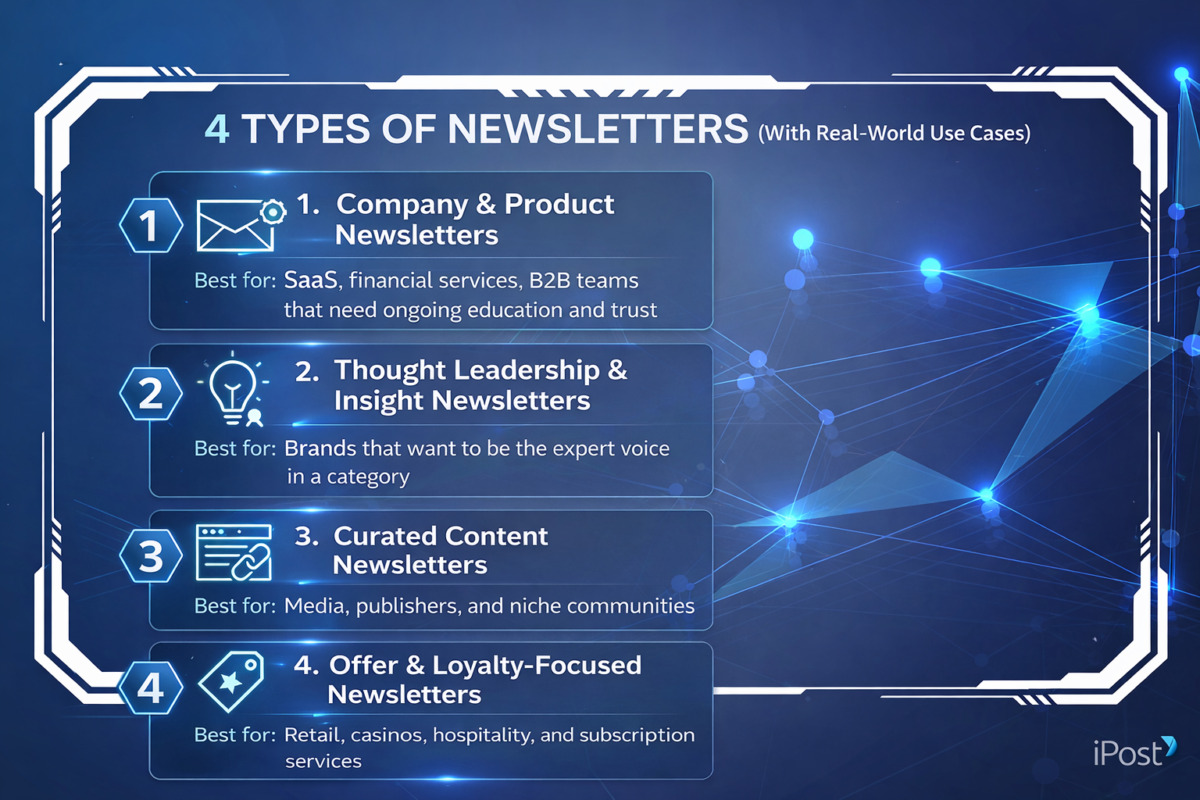
You’ll see a lot of overlap, but most newsletters fall into a few patterns:
1. Company & Product Newsletters
- Product updates and releases
- Roadmap and feature previews
- Customer stories and case studies
Best for: SaaS, financial services, B2B teams that need ongoing education and trust.
2. Thought Leadership & Insight Newsletters
- Opinion pieces, frameworks, and “how we think” content
- Deep dives on industry trends
- Curated articles with expert commentary
Best for: Brands that want to be the expert voice in a category.
3. Curated Content Newsletters
- “Best of” roundups from around the web
- Links to blogs, videos, and resources with short commentary
- Minimal original writing, maximum curation value
Best for: Media, publishers, and niche communities.
4. Offer & Loyalty-Focused Newsletters
- Exclusive deals and promotions
- Loyalty point reminders and perks
- Early access to events, sales, or drops
Best for: Retail, casinos, hospitality, and subscription services.
For example, a casino using iPost might send a monthly loyalty newsletter that combines:
- Upcoming entertainment
- Tier-specific offers
- Responsible gaming reminders
- Local events and community stories
Backed by a player-aware data model, that newsletter is more relevant than a generic “offers” blast.
What Makes a Good Newsletter in 2026?
The basics haven’t changed, but the bar has.
Effective newsletters now share a few traits:
Clear Audience and Goal
Before you design anything, answer:
- Who is this for? (Customers, prospects, partners, VIPs?)
- Where are they in the journey? (New, active, lapsed?)
- What do we want this newsletter to do? (Educate, drive demos, drive bookings, etc.)
Vague audience = vague newsletter.
Strong, Honest Subject Lines
Subject lines don’t need to be clickbait. They need to be:
- Specific (“3 ways to improve your casino email segmentation”)
- Useful (“New feature: automated age gating in iPost”)
- On-brand (tone that matches the rest of your communications)
Your email open rate will tell you if you’re getting this right, see Understanding Email Open Rates for a deeper dive.
Scannable, Mobile-First Layout
Most subscribers will first see your newsletter on a phone.
Design for that:
- Short paragraphs and clear subheads
- One main idea per section
- Buttons that are easy to tap
- Images that support the message, not distract from it
If the first screen is a wall of text, the back button wins.
Focused Calls-to-Action (CTAs)
Every newsletter doesn’t need to sell—but it should gently guide the reader:
- Read the full article
- Watch the webinar replay
- Explore the new feature
- Book a demo or schedule a visit
Your click-through rate (CTR) and click-to-open rate (CTOR) will show whether the content and CTAs are working. You can review those concepts here:
Consistent Cadence (Without Fatigue)
Newsletters work best when subscribers:
- Know roughly when they’ll hear from you
- Don’t feel bombarded
- Don’t forget who you are between sends
Most brands land somewhere between weekly and monthly, with more frequent sends reserved for highly engaged segments.
If you’re wrestling with cadence, this guide will help:
How Often Should You Email Your List? 2026 Guide for Casinos, Hotels, and Franchises
How Do You Measure a Newsletter’s Success?
The nice part about newsletters: they’re measurable. You don’t need to guess.
Most teams track four core metrics:
Open Rate
- How many people opened the newsletter
- Indicates inbox placement + subject line + sender trust
Click-Through Rate (CTR)
- How many recipients clicked at least one link
- Tells you whether the topic and offers were compelling
Click-to-Open Rate (CTOR)
- How many openers clicked
- Shows whether your content delivered on the subject line’s promise
Unsubscribe & Spam Complaints
- How many people opted out or complained
- Signals whether you’re sending the right content to the right audience at a reasonable frequency
Over time, you’ll also look at:
- Traffic and conversions driven from newsletter clicks
- Revenue per send / per subscriber
- List growth vs. churn
If you want to go deeper into each metric, your iPost metrics cluster already covers it:
- Understanding Email Open Rates
- Click-Through Rate (CTR) in Email Marketing
- Click-to-Open Rate (CTOR) in Email Marketing
How Enterprise Brands Use Newsletters (Casinos, Hospitality, Franchises, Financial Services)
At iPost, we see newsletters used very differently across highly regulated, data-sensitive industries.
A few patterns:
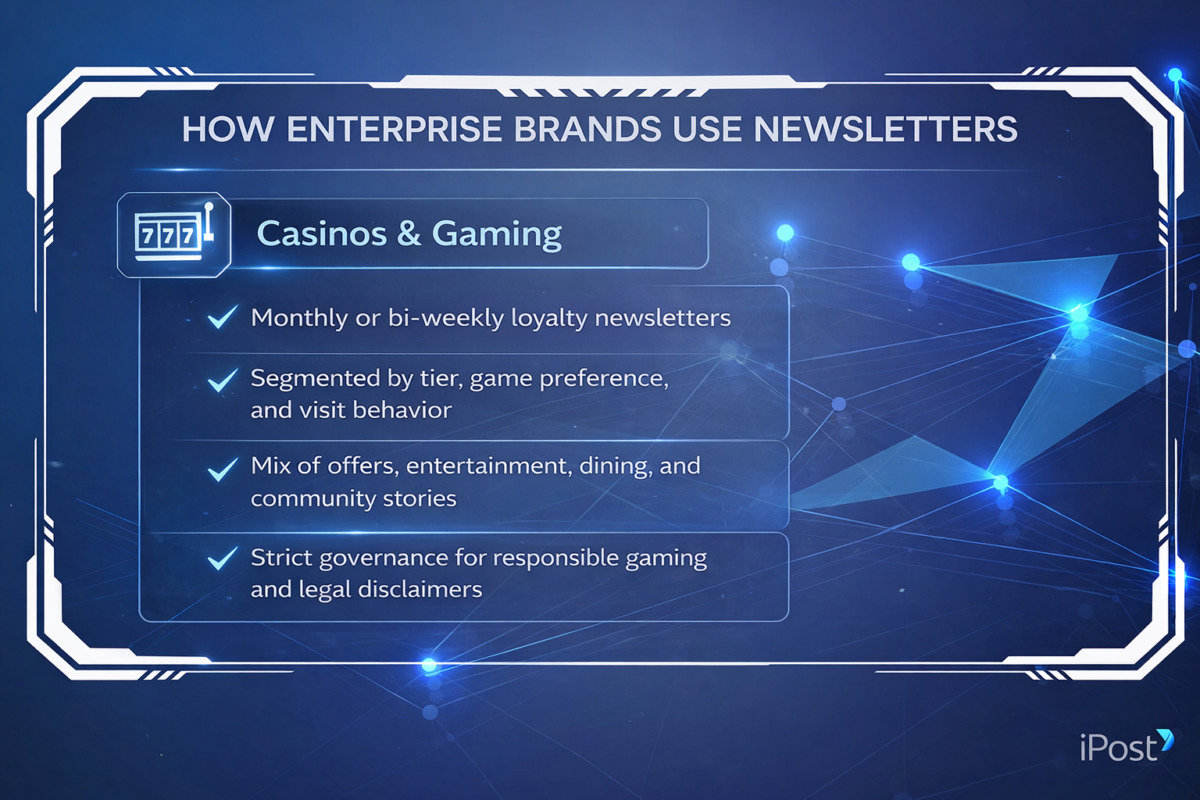
Casinos & Gaming
- Monthly or bi-weekly loyalty newsletters
- Segmented by tier, game preference, and visit behavior
- Mix of offers, entertainment, dining, and community stories
- Strict governance for responsible gaming and legal disclaimers
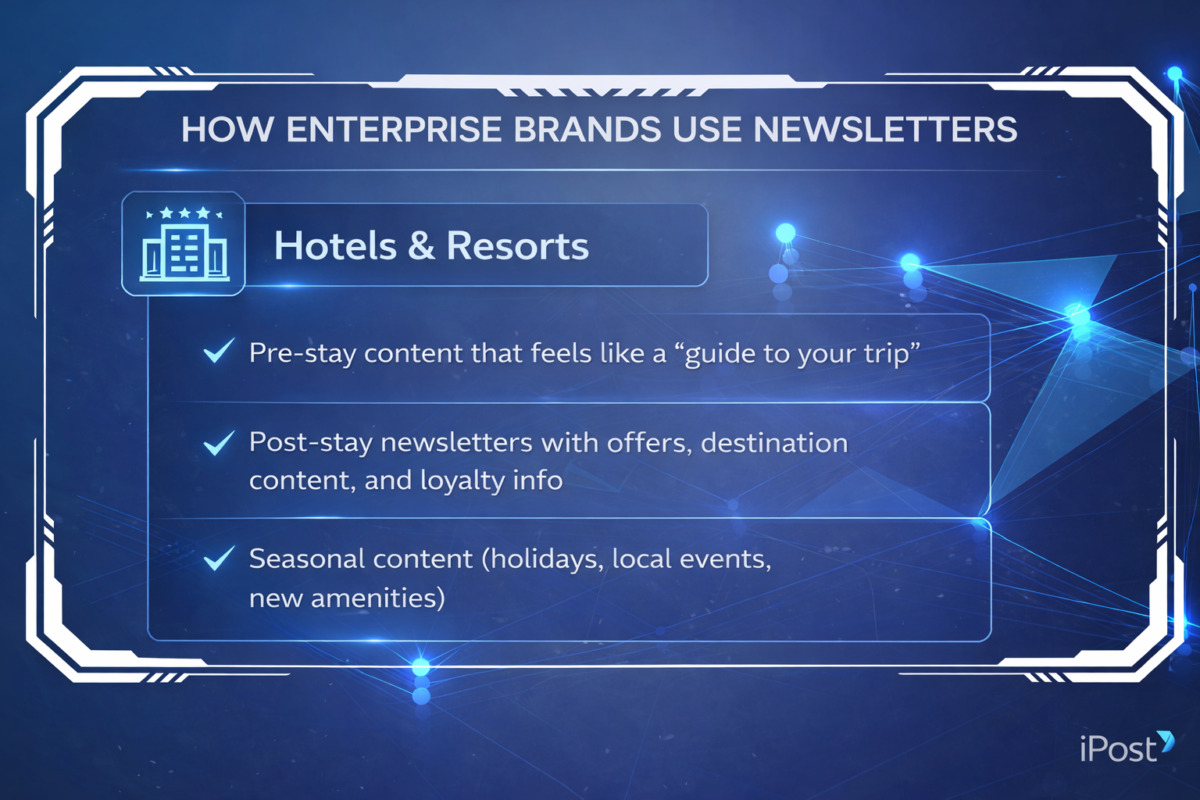
Hotels & Resorts
- Pre-stay content that feels like a “guide to your trip”
- Post-stay newsletters with offers, destination content, and loyalty info
- Seasonal content (holidays, local events, new amenities)
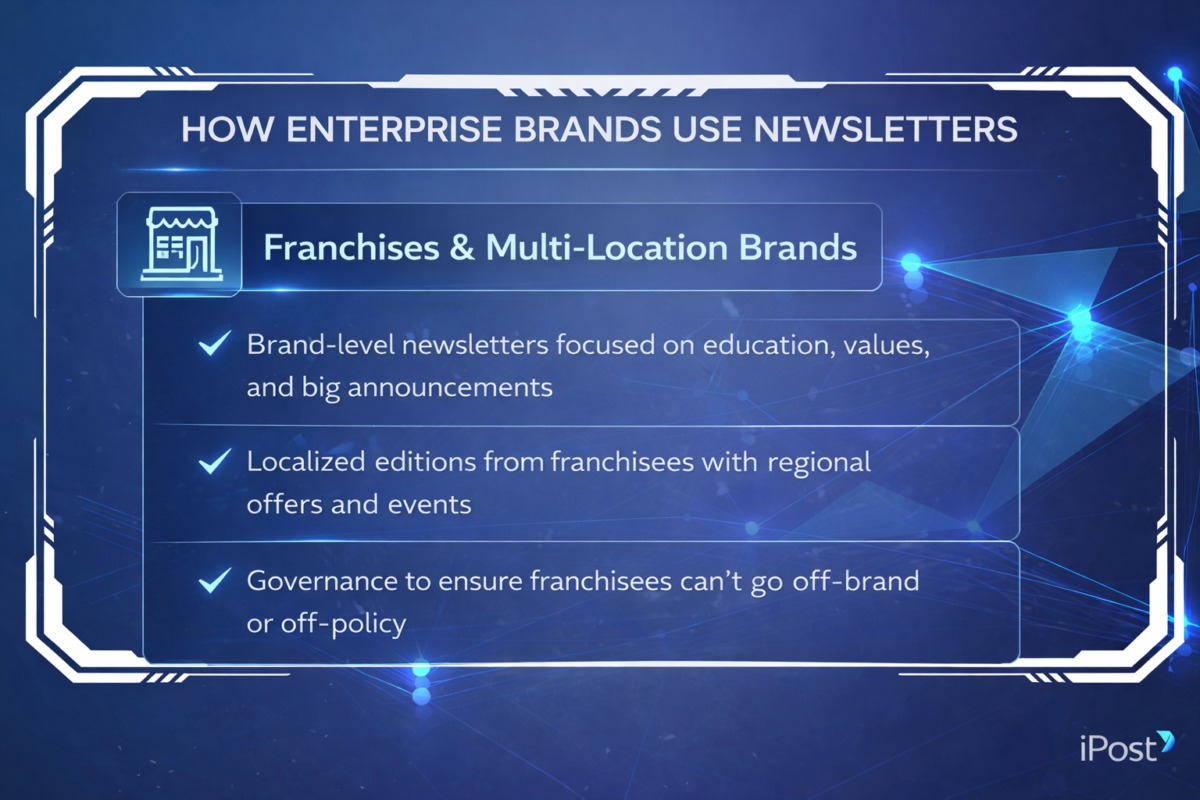
Franchises & Multi-Location Brands
- Brand-level newsletters focused on education, values, and big announcements
- Localized editions from franchisees with regional offers and events
- Governance to ensure franchisees can’t go off-brand or off-policy
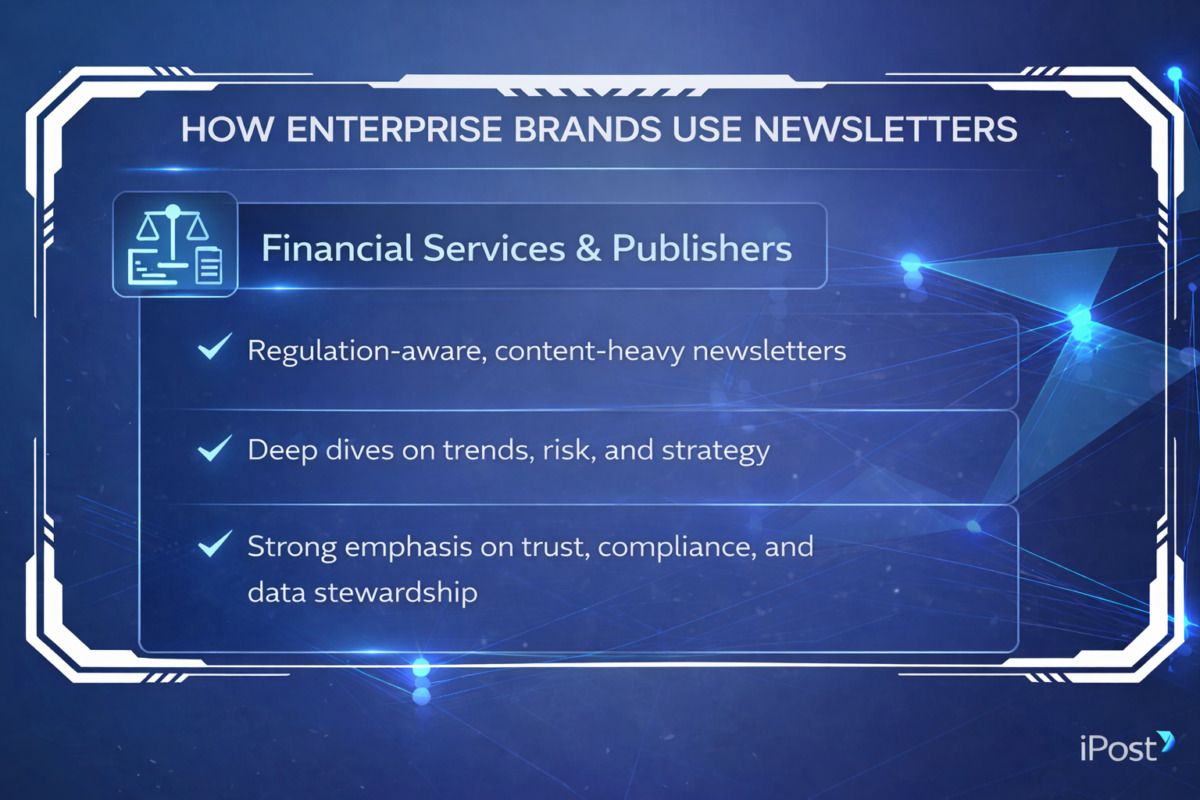
Financial Services & Publishers
- Regulation-aware, content-heavy newsletters
- Deep dives on trends, risk, and strategy
- Strong emphasis on trust, compliance, and data stewardship
For these organizations, a newsletter isn’t just another content format, it’s a governed channel that sits on top of sensitive data and strict rules. That’s why many choose a platform like iPost, which was built for regulated and data-sensitive industries from day one.
Newsletter FAQ
What Is A Newsletter
A newsletter is a recurring email that shares updates, insights, and curated content with a subscribed audience. Its primary job is to deliver ongoing value, build trust, and keep your brand top-of-mind—not just push one-off sales.
How is a newsletter different from a regular marketing email
A “regular” marketing email is often tied to a specific promotion or campaign. A newsletter feels more like a publication—an ongoing series with a recognizable format, recurring sections, and a broader purpose than a single offer.
How often should I send a newsletter
There’s no one perfect answer, but most brands land on:
- Weekly or bi-weekly for fast-moving industries and engaged audiences
- Monthly for deeper content or slower cycles
The key is to watch your open rates, CTR, and unsubscribes as you adjust cadence. If you want a more structured framework, see:
How Often Should You Email Your List? 2026 Guide for Casinos, Hotels, and Franchises
What should I put in a newsletter
At minimum:
- A clear headline and subject line
- 1–3 main content blocks (articles, insights, or updates)
- A visible call-to-action (or a few, if clearly organized)
- Optional: curated links, event highlights, or feature spotlights
If it doesn’t educate, inform, or move someone closer to a decision, it probably doesn’t need to be there.
Do I need a special platform to send newsletters?
You’ll want an email service provider (ESP) or marketing platform that can:
- Manage permissions and consent
- Handle templates and design
- Support segmentation and personalization
- Track open rate, CTR, CTOR, and conversions
For casinos, hospitality, financial services, and multi-brand enterprises, it also needs to handle compliance, complex data, and governance—which is exactly why iPost exists.
To see how that looks in practice, explore:
Email Solutions for Casinos and Email Compliance Software: What Enterprise Marketers Need to Know.
Bottom line:
A newsletter isn’t just “an email with some links.” It’s a repeatable, measurable, value-driven publication in the inbox.
Get the purpose right, keep your promise on cadence and quality, and connect it to the right data and ESP—and it becomes one of the most durable assets in your entire marketing stack.