

The short answer
To win back inactive casino players, identify lapsed players by recency and theoretical value, segment them by why they left, and run a timed email reactivation campaign that leads with a reason to return rather than a generic discount. The strongest win-back programs combine clean player data, a personalized offer tied to each player's worth, and disciplined deliverability so your emails actually reach the inbox. Done well, reactivation is the cheapest revenue a casino marketing team can find, because winning back a known player costs far less than acquiring a new one.That is the summary. The rest of this guide shows you exactly how to build it.
What counts as an "inactive" casino player?
An inactive (or lapsed) player is someone who used to visit or play and has now gone quiet for a defined window. The window depends on your property and your typical trip frequency.
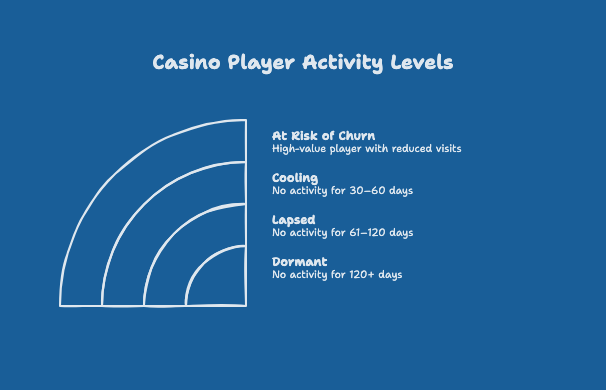
For most casinos, a useful starting definition looks like this:
- Cooling: No tracked visit or play in 30–60 days.
- Lapsed: No activity in 61–120 days.
- Dormant: No activity in 120+ days.
- At risk of churn: A previously high-value player whose visits have dropped sharply, even if they have not fully stopped.
The exact day counts matter less than drawing the lines and acting on them. The point is to catch players while the relationship is cooling, not after it has gone cold. If you are still building the data foundation to do this, start with the fundamentals in Casino Marketing 101 and our best practices for casino player acquisition, since the same player data that powers acquisition powers reactivation.
Why win-back beats acquisition
Reactivation works because you already have the data. You know what a lapsed player wagered, which games they favored, when they last visited, and how much they are worth. New players give you none of that until you earn it.
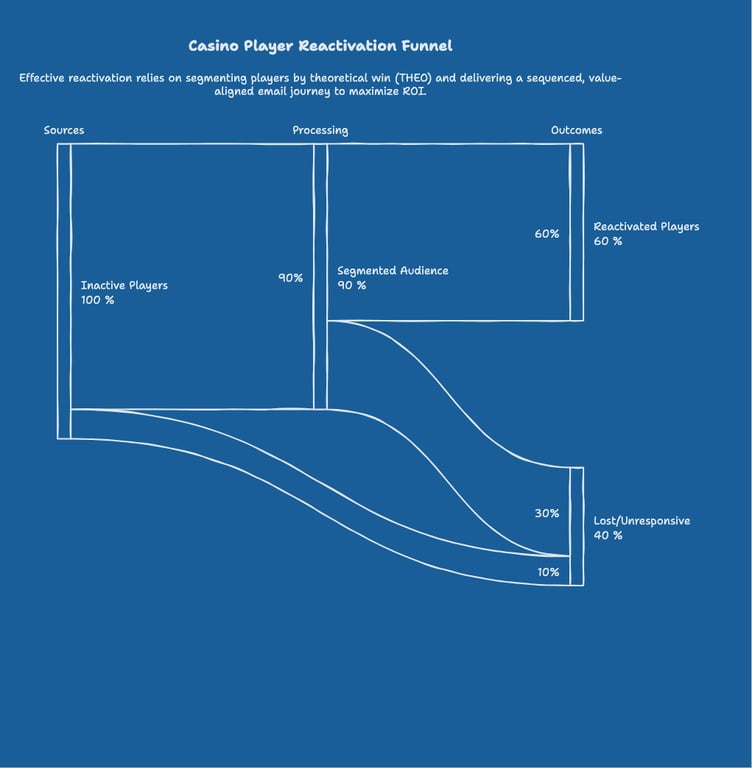
This is where THEO, or theoretical win, becomes your most important number. THEO tells you what a player is actually worth over time, so you can decide how hard to fight to bring each one back. A dormant high-THEO player deserves a real offer and a host's attention. A low-THEO player deserves an automated, low-cost nudge. Spending the same on both is how reinvestment budgets get wasted.
Step 1: Segment your inactive players before you send anything
A single "we miss you" email blasted to every quiet address is the most common reactivation mistake. It ignores why each player went quiet, and it risks your sender reputation. Segment first.Build your win-back audience around three questions:
- How valuable were they? Rank by THEO or average daily worth, not just visit count.
- How long have they been gone? Cooling players need a light touch. Dormant players need a stronger reason to return.
- What did they do before? Slot players, table players, hotel guests, and event-driven visitors all come back for different reasons.
The result is a handful of meaningful segments instead of one undifferentiated list. If segmentation feels out of reach with your current tools, that is usually a platform problem, not a strategy problem. The best email service provider for gaming lets you segment on player ID and gaming data, not just an email address.
Step 2: Build the reactivation email journey
Win-back is a sequence, not a single send. A simple, effective journey runs three to four emails over two to three weeks:
- Email 1 — The reminder. Lead with the experience and what is new, not a discount. Remind them why they liked your property. Keep it warm and short.
- Email 2 — The offer. Now bring the incentive, sized to the player's value: free play, a dining credit, a hotel comp, or event access. Tie it to what that segment actually responds to.
- Email 3 — The deadline. Add urgency with a clear expiration. Loss aversion does real work here.
- Email 4 — The last call (optional). A final, friendly nudge for anyone who has not engaged, before you slow down contact.
Each email should have one clear job and one clear call to action. For the mechanics of building campaigns like this as a connected system rather than one-off blasts, see our guide on how to design effective casino email marketing campaigns.
Step 3: Make the offer match the player
The offer is where reactivation budgets are won or lost. A few rules that hold up across properties:
- Scale the incentive to THEO. Your best lapsed players justify a generous offer. Your casual players do not.
- Lead with experience for cooling players, and with value for dormant ones. The longer someone has been gone, the more concrete the reason to return needs to be.
- Use offers you already run well. You do not need to invent anything exotic. Plenty of proven plays live in our roundup of casino promotion ideas.
- Reinforce the brand, not just the deal. Players return to places they feel something for. That emotional pull is the job of casino branding, and your win-back emails should carry it.
Step 4: Get the timing and frequency right
Send too rarely and the player forgets you. Send too often and you train them to ignore you or unsubscribe. Reactivation needs more contact than a normal broadcast, but only over a defined window, and then you ease off.
There is no universal magic number, which is why frequency should be a data decision based on opens, clicks, and unsubscribes per segment. Our guide to how often you should email your list walks through how to set cadence for casinos specifically. The principle for win-back: concentrate your sends inside the campaign window, then return quiet players to your normal rhythm or sunset them.
Step 5: Protect deliverability when re-engaging old addresses
This is the step most teams skip, and it quietly sinks win-back campaigns. Inactive players often mean inactive email addresses, and mailing a large list of unengaged or stale contacts can trigger spam traps and hurt your sender reputation. If your reactivation emails land in spam, nothing else you did matters.
Protect yourself with a few habits:
- Warm into the segment. Start with the most recently active of your lapsed players and expand outward, rather than blasting your oldest addresses first.
- Watch engagement signals. Rising bounces or spam complaints are a stop sign. Track them alongside your email open rates and click-through rates.
- Set a sunset policy. If a player ignores the full win-back sequence, stop active mailing to protect the inbox placement of your engaged list.
- Stay compliant. Regulated gaming communications carry rules, and a platform built for compliance matters. See why that is the core of the best email compliance software for regulated industries.
Step 6: Measure what actually matters
Opens and clicks tell you whether the email worked. They do not tell you whether the campaign worked. Tie reactivation back to the floor.
Track:
- Reactivation rate: the share of targeted lapsed players who returned and were tracked.
- Incremental THEO: the theoretical win generated by reactivated players, versus the cost of the offers.
- Cost per reactivation: compared against your cost to acquire a new player.
- Repeat behavior: whether reactivated players stay active or lapse again, which tells you if your follow-up is working.
If connecting email results to gaming revenue is hard today, that gap is exactly what a gaming-built platform and an experienced services team are for. Our managed services and casino email solution are designed to close it.
Common win-back mistakes to avoid
- Blasting every inactive address at once and torching your sender reputation.
- Leading with a discount before giving a reason to care.
- Offering the same incentive to a whale and a once-a-year casual player.
- Running a single email instead of a sequence.
- Never setting a sunset rule, so dead addresses drag down your whole program.
Avoiding these five mistakes puts you ahead of most properties. If you want a partner who lives in this work, our breakdown of what strong casino marketing specialists actually do is a useful next read, alongside the strategic role of owned email in our casino public relations guide.
Frequently asked questions
How long should a casino wait before a player is considered inactive?
For most casinos, 60 days without tracked play is a reasonable "cooling" threshold, with lapsed at 90–120 days and dormant beyond 120. Adjust the windows to your property's normal trip frequency.What is the best offer to win back lapsed casino players?
The best offer is one scaled to the player's theoretical value. High-THEO players justify generous free play, dining, or hotel comps, while casual players should receive lower-cost, automated incentives.How many emails should a win-back campaign include?
Three to four emails over two to three weeks works well: a reminder, an offer, a deadline, and an optional last call. Then return the player to your normal cadence or sunset them.Can win-back emails hurt email deliverability?
Yes. Mailing large volumes of stale, unengaged addresses can trigger spam traps and damage sender reputation. Re-engage your most recent lapsed players first and set a sunset policy for non-responders.Turn inactive players into active revenue
Winning back inactive casino players is the highest-return work your marketing team can do, because the players already know you and the data already exists. Segment by value, sequence your emails, match offers to worth, and protect deliverability, and reactivation becomes a repeatable revenue engine rather than a one-time campaign.
iPost is built for exactly this kind of data-driven, compliant casino email.
See how the iPost casino email solution helps you win back players, or book a demo.